
Chickweed
Chickweed is a winter gift for salads or pesto.
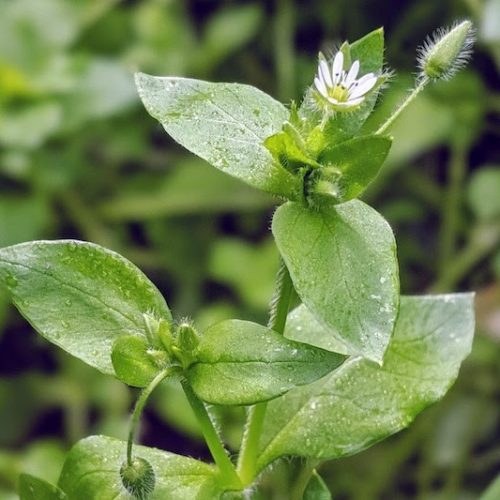
The name “chickweed” most notably describes Common Chickweed (Stellaria media), although there are several other chickweeds, all in the genus Stellaria.
It’s often found in lawns and other areas of sun to partial shade in moist soil.
The stringy but succulent stems of chickweed can grow up to a foot and a half or so and produce tiny white flowers throughout the growing season.
How to identify it
It has a few lookalikes but a few distinguishing factors are:
- Chickweed does not have milky sap. Try pulling the stem apart. If there’s no milky sap, you’re more likely to have chickweed.
- It has a line of “hair” along the stem, which alternates between the joints.
- The inner stem of chickweed is elastic, so if you gently pull the stem apart, the outer sheath will separate while the inner part will stretch.
In the kitchen
Chickweed is not only a super plant in terms of its nutritional acclaim, but it’s also delicious. It’s pleasant and mild.
Chickweed is excellent raw — use it like sprouts; eat it in sandwiches, wraps, etc. And of course it’s a great base for salad.
It’s also great cooked and makes a good substitute for spinach.
Several sources say it’s high in vitamins C, B, and A, as well as a host of minerals and other healthful constituents.
Traditional uses
Chickweed was used traditionally as a restorative tonic for patients recuperating from serious illness. It’s presumably the plant’s nutrient content that provides healing support.
Chickweed actually has several traditional uses both internally and externally:
- Anti-inflammatory and pain reliever — a traditional remedy for rheumatism, arthritis, menstrual cramps and other issues associated with inflammation.
- Digestive and intestinal support — chickweed’s high fibre content and its reputation for improving the absorption of nutrients makes it an old stand-by tonic for gut health.
- Skin treatment — chickweed is cooling and drying so it has a long history of use in treating skin afflictions like acne, eczema, psoriasis, rashes, minor burns, boils, cuts, and insect bites. It’s also good as a compress for soothing haemorrhoids and varicose veins.
- Kidney support — as a mild diuretic, chickweed tea is traditionally administered to flush and clean the kidneys.
- Astringent — a compress, tincture, or fresh juice of chickweed is used to draw out splinters.
Harvesting
Chickweed doesn’t do well refrigerated which probably explains the fact that it never made it as a commercial crop, even though it was a popular edible garden plant in the 1800s. It’s best eaten fresh so plan to use it within a day or so of cutting. Eat the stems, leaves, flowers, and seed pods.
Since chickweed is so prolific, it’s really easy to get enough for a meal or 10 in a short time.
It’s excellent eaten raw; put it in a salad or prepare as you would spinach: steamed or sauteed.